Image Credit: Joost J. Bakker from IJmuiden, CC BY 2.0, via Wikimedia Commons
If you have followed this series, you would have noticed some recurring themes. World War II, infrastructure destruction, resource shortages – funding, fuel, material, etc. The need to rebuild was urgent, and one of the most important necessities for getting a country back on its feet was mobility for farmers, tradespeople, small businesses, and working families. In every story we have covered, one vehicle has played a critical role in rebuilding yet remained in the background. That vehicle is the Willys Jeep. It is time to elevate it from a supporting role to the main character.
America is credited with many products that changed people’s lives. As an automotive nerd, I put the Willys Jeep near the top of that list.
Unlike every other vehicle in the Necessity Files series, the Jeep was not born from the needs of a peacetime society rebuilding after hardship. It was born in the hardship itself, designed under one of the most compressed and demanding briefs in automotive history, while the world was tearing itself apart. Today, an automotive company spends between three and five years and hundreds of millions of dollars on research and development before bringing a new vehicle to market. The Willys Jeep prototype was built in just 49 days.
Forty-Nine Days
In July 1940, Europe was already at war, and America was watching from the sidelines, imagining the inevitable. The US Military realized that if it joined the war, its slow infantry could be a serious limitation. An urgent request for proposal was issued to 135 automotive manufacturers. The proposal specified the need for a lightweight, four-wheel-drive reconnaissance vehicle capable of carrying men and equipment across any terrain. The specifications were exacting: a maximum wheelbase of 75 inches, a maximum weight of 1,300 pounds, four-wheel drive, a fold-down windscreen, and a payload of 660 pounds. Companies had eleven days to submit their bids, 49 days to deliver a working prototype, and 75 days to deliver 70 test vehicles – a seemingly impossible task by any measure.
General Dwight Eisenhower named it one of the three (or five – this information is contested) pieces of equipment most critical to the Allied victory.
Of the 135 manufacturers approached, only three responded: the American Bantam Car Company, Willys-Overland Motors, and Ford. Though Bantam delivered the prototype within the 49-day window, it lacked the capacity to produce the required volumes. Willys and Ford were also brought in alongside and given access to Bantam’s design – a decision still unpopular with historians. The resulting design combined the best of all three: Bantam’s chassis, Ford’s flat hood and stamped grille, and Willys’ legendary Go-Devil engine, which outmuscled both rivals with 60 horsepower and 105 foot-pounds of torque. Willys won the primary contract, with Ford brought in as a second manufacturer to meet demand, which is why both the Willys MB and the Ford GPW existed side by side throughout the war.
As for the name, its precise origin remains contested. The most likely origin is the military designation “GP” for “General Purpose”. Whatever the origin, it stuck, and Willys trademarked it.
It Went Everywhere
During the war, between Willys and Ford, over 600,000 Willys MBs and Ford GPs were produced, of which nearly 30% were shipped to Allied forces in Britain and the Soviet Union. Every theatre of the war was served by the Jeep – the deserts of North Africa, the hedgerows of Normandy, the jungles of the Pacific. It served as a reconnaissance vehicle, an ambulance, a gun platform, a cable-layer, a fire-fighting pumper, and, with suitably adapted wheels, even ran on railway tracks. General Dwight Eisenhower named it one of the three (or five – this information is contested) pieces of equipment most critical to the Allied victory.
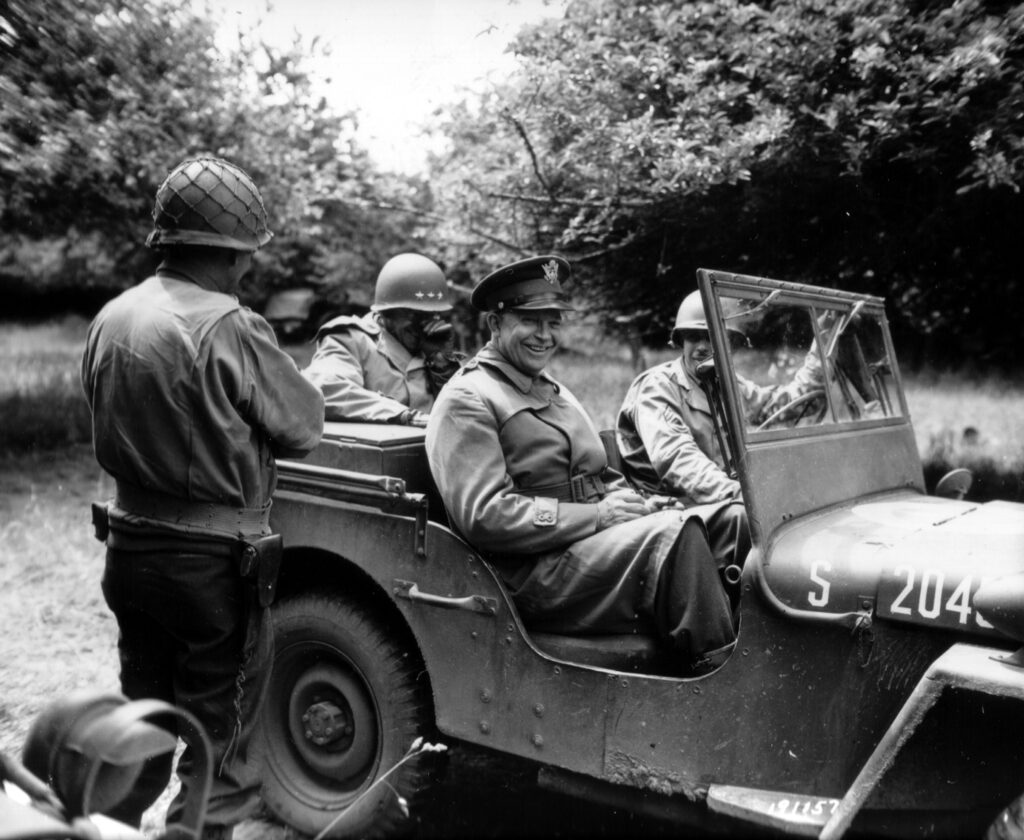
Image Credit: US Army Signal Corps / Conseil Régional de Basse-Normandie / National Archives USA, Public domain, via Wikimedia Commons
It is difficult to point to any single feature that made the Jeep remarkable. Rather, it was how the whole package came together to do what it could. It was light enough to be loaded into a transport aircraft and dropped behind enemy lines. It was rugged enough to ford rivers, cross ploughed fields, and climb mountain paths. It was simple enough that a soldier with basic mechanical training could fix it in the field. And it was produced in sufficient numbers for every infantry regiment in the US Army to receive a good supply.
American forces returned home after the war, leaving behind a surplus of equipment, including many Jeeps. Local farmers found them surprisingly useful, and engineers reverse-engineered them to produce vehicles such as the British Land Rover and the Japanese Land Cruiser.
The Uniform Comes Off
Many soldiers who had driven Jeeps across the fields of Europe and the Pacific came home to farms of their own, already knowing exactly what the vehicle could do. What had worked on a battlefield would work just as well on a farm.
Willys had already anticipated this. In 1944, the company smartly pivoted, developing a civilian version and branding it as a motorized horse for the American farmer. The result, launched in 1945, was the CJ-2A, “CJ” standing for Civilian Jeep and marketed as a tractor replacement.
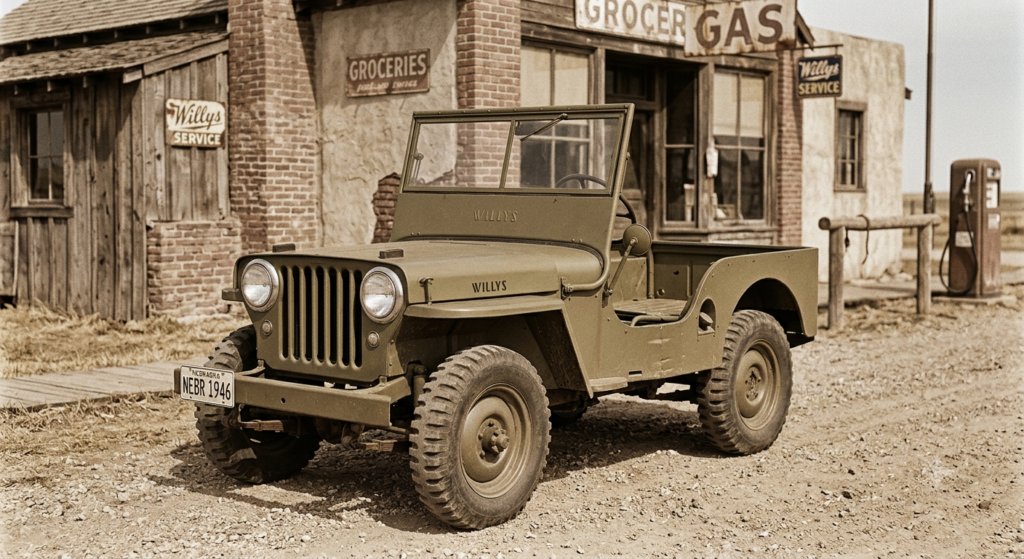
It retained the core of the military vehicle but added a tailgate, a side-mounted spare, and civilian lighting. The CJ-2A could be fitted with a Power Take-Off to drive ploughs, pumps, and saws directly from the engine. We saw the same concept later appear on the Land Rover.
The World Follows
The Jeep’s influence spread far beyond American farms. Willys licensed the design to manufacturers worldwide. In India, Mahindra began assembling Jeep kits in 1947. To this day, Mahindra vehicles reflect the Jeep influence. Mitsubishi built licensed Jeeps in Japan until 1998. The Toyota Land Cruiser traces its origins directly to a captured American military Jeep that Japanese forces reverse-engineered during the war. The Land Rover, as readers of this series will know, was built on a surplus Jeep chassis. The Nissan Patrol, the Mercedes G-Class, and the entire global family of off-roaders all owe their existence, in some measure, to what three companies built in 75 days in 1940.
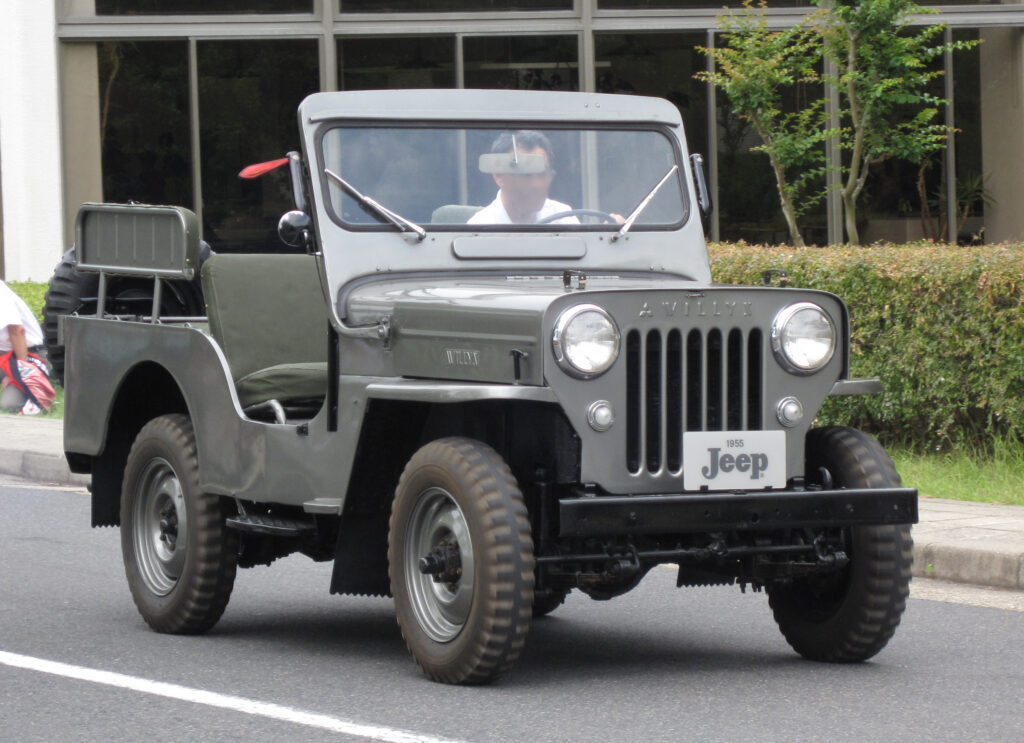
Image Credit: 1955 Mitsubishi Jeep, Mitsupicture, CC BY-SA 3.0, via Wikimedia Commons
Simplicity is the Ultimate Sophistication
The most enduring vehicles are often the ones built not for profit or prestige, but because a very specific, urgent need left designers with no choice but to get it right. With limited access to funding and materials, they had to keep it simple, and that simplicity was the key to making every vehicle in this series successful.
