Image Credit: 1981 Citroën H Van, Stahlkocher, CC BY-SA 3.0, via Wikimedia Commons
Citroën played such an important part in rebuilding France after WWII that the story of the 2CV wasn’t enough. For our last article in this series, we crossed the English Channel to bring you the story of Land Rover Series 1. We are once again drawn back to France because another Citroën deserves its own place in this series. That vehicle is the Citroën H Van.
We have already met Pierre-Jules Boulanger, the man whose epiphany while stuck behind a farmer’s cart on a muddy track led to the birth of the 2CV. Boulanger was a patriotic man, a trait common among the population under attack from the Axis Powers. He was also a visionary who retained a strong sense of realism. We saw one side of this pragmatism with the 2CV, which he created to provide personal mobility for the French farmer and the rural working class. But he also realized that he had only solved half the problem. Post-war France was crawling back to its feet, and the people doing the crawling – the bakers, the butchers, the market traders, the building contractors, the small artisans who formed the backbone of the French economy – needed more than a car; they needed a van.
When planning for the 2CV in the late 1930s, he had also commissioned an investigation of how small businesses moved their goods. The research was exhaustive, with photographs, sketches, and interviews with tradespeople from small village craftsmen to company managers. The picture that emerged was that of a van with specific characteristics. The driver had to sit as far forward as possible, above the front axle, to maximize cargo space without making it too long. The cargo area had to be tall enough to stand in. It had to be accessible from the driver’s seat without stepping outside. There had to be a side door facing the pavement for easy loading and unloading. And, similar to the 2CV, it had to be cheap to build, cheap to run, and simple enough for a small-business owner to maintain. Although the war had a significant influence on the final product, the basic concepts remained in place.
It was boxy and ribbed, with a distinctive nose that earned it the nickname Nez de Cochon (Pig’s Nose). But the necessity was so pure that it stayed in production for 34 years (1947–1981) virtually unchanged.
Boulanger’s team did build a van, the Citroën TUB, in 1939 with these specs, but the war cut production short after only about 1,740 units were built. When peace returned, the team went back to work, this time with a larger, more capable successor in mind.
Boulanger tasked Pierre Franchiset with designing the body of the new van. The result, introduced at the 1947 Paris Motor Show, was a vehicle that looked like nothing else on the road – a tall, boxy van clad entirely in corrugated steel panels. Its ribbed skin gave it the appearance of a small shed on wheels.
An interesting contrast was the reaction compared to that of the 2CV. While the 2CV was met with much ridicule, especially from the media, the H van was recognized for what it offered. Orders started flowing in almost immediately from small businesses and tradespeople. There is no denying that it looked bizarre. It was boxy and ribbed, with a distinctive nose that earned it the nickname Nez de Cochon (Pig’s Nose). But the necessity was so pure that it stayed in production for 34 years (1947–1981) virtually unchanged.
The corrugated panels were not for style. As with the other stories in the Necessity Files series, it was a solution born of constraint. Franchiset borrowed the idea directly from the Junkers aircraft of the wartime era, where corrugated metal had long been used to add structural rigidity without adding weight or requiring expensive tooling. The ribs stiffened the panels so effectively that the welded floor, according to Citroën, was strong enough to support the weight of a horse – one of the necessary features for the target market.
Underneath the corrugated skin, the engineering was equally thoughtful. The front-wheel-drive layout meant there was no drive shaft running along the floor of the cargo area. The result was a low and completely flat loading floor. The engine was mounted at the very front of the vehicle, ahead of the gearbox, freeing up more load space. Independent suspension, rack-and-pinion steering, and a unibody structure gave the H Van a ride quality and handling that surprised everyone who drove it.
Though the designers hadn’t intended for it, the Van’s design gave it another important benefit. With buildings and stores bombed out, the van started serving as a mobile storefront.
Before the H Van, commercial vehicles were just passenger cars with a box welded onto the back. They had rear-wheel drive, meaning a bulky driveshaft ran under the floor, forcing the cargo bed to be high off the ground. Workers spent their days breaking their backs lifting heavy crates up into the van. The H Van made the old rear-wheel-drive format look immediately obsolete.
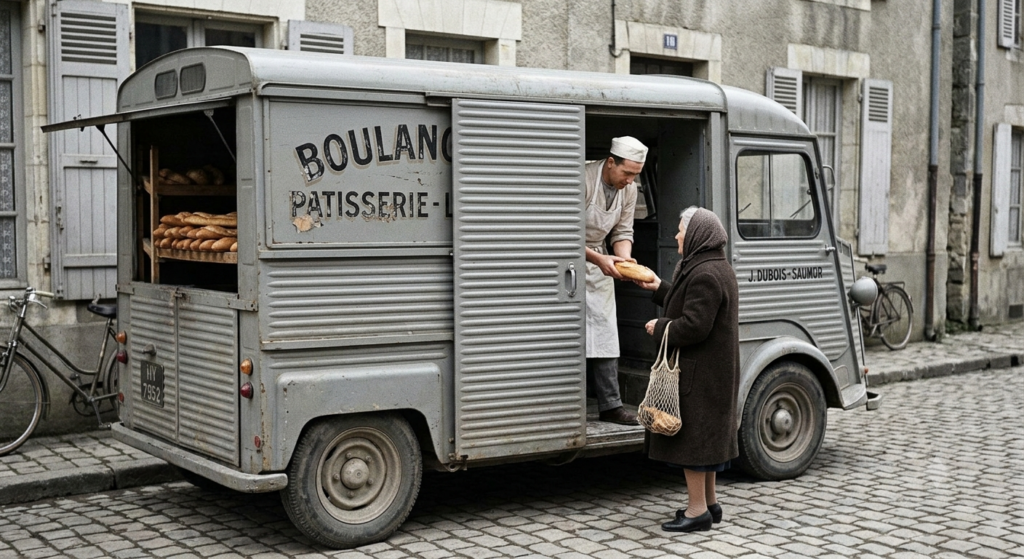
Though the designers hadn’t intended for it, the Van’s design gave it another important benefit. With buildings and stores bombed out, the van started serving as a mobile storefront. The side door and low floor meant the customers could buy things like a loaf of bread from the street, while the tall body allowed a baker to stand upright and serve their customers.
Commercial sales began in June 1948, just months after the 2CV’s debut at the same Paris Motor Show. The H Van found its customers almost immediately. Bakeries used it to deliver bread before dawn. Market traders loaded it with produce and drove it to the village square. Building contractors packed it with tools. Postal services and fire brigades ordered it in numbers. The chassis-cab variant was sent to specialist coachbuilders, who fitted it with cattle-truck bodies, refrigerated units, mobile laboratories, and even ambulances. The versatility of the platform seemed almost limitless.
What is remarkable, in retrospect, is how little the design needed to change. The basic shape introduced in 1947 remained in production, with only minor refinements, for thirty-four years. A single windscreen replaced the original split windscreen in 1964. The rear wing shape was updated in 1969. That was, more or less, the extent of it. The van’s recipe was so well suited to what tradespeople needed that there was simply no reason to change it. By the time production finally ended in 1981, just under half a million H Vans had been built across factories in France, Belgium, and the Netherlands. Its legacy is visible in every van that followed. The working van, as the world knows it today, owes its DNA in no small part to what Boulanger and Franchiset designed in post-war Paris.
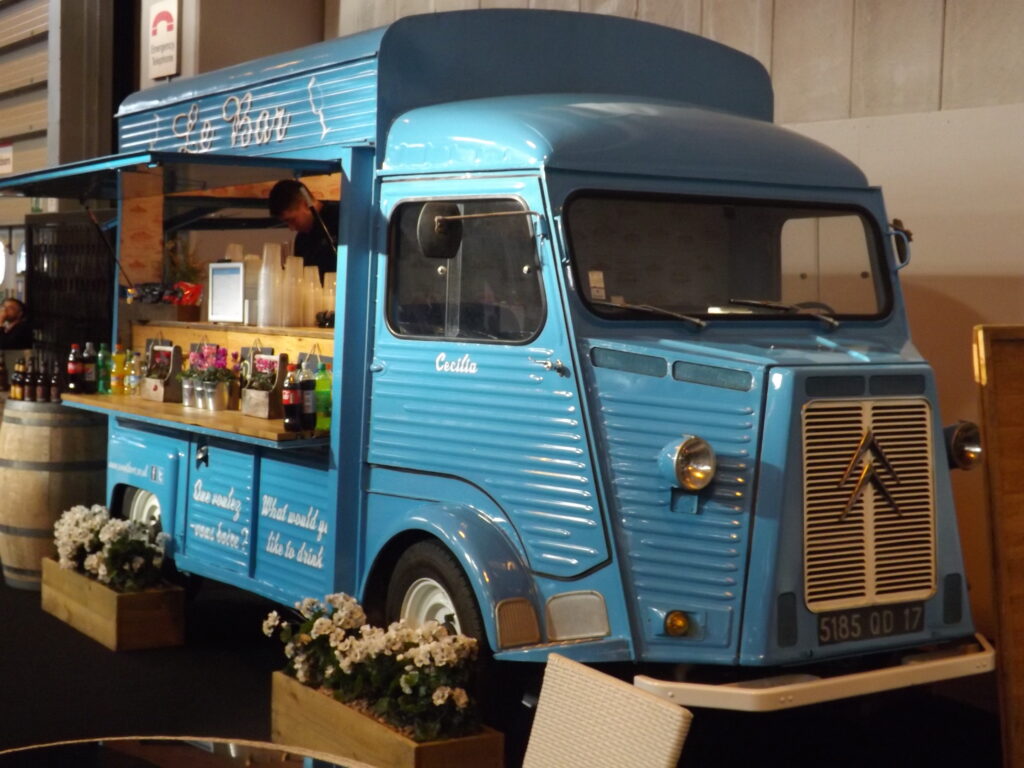
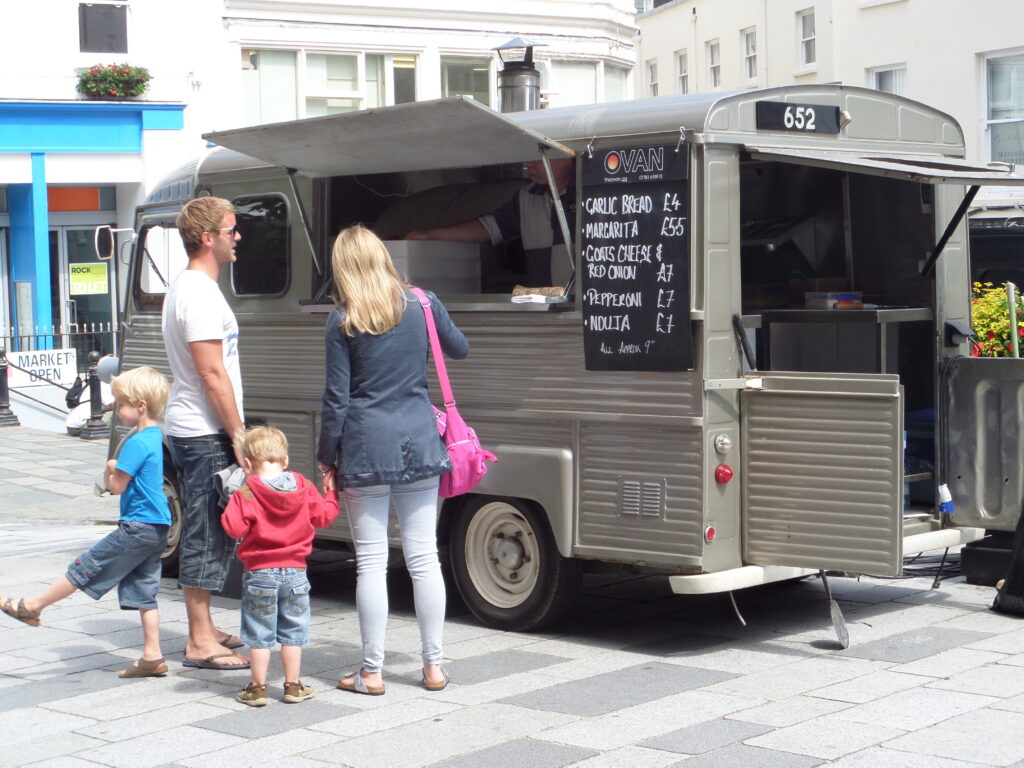
Image Credits: Andrew Bone from Weymouth, England, CC BY 2.0, via Wikimedia Commons
Today, restored examples still appear at food festivals and street markets across France and beyond, their corrugated flanks repainted in bright colors, dispensing coffee, crêpes, and artisan produce to appreciative crowds. It is a second life that would surely have delighted Boulanger – the van he built to serve the French tradesperson has become a legacy, beloved precisely because it looks like nothing else.
