Image Credit: Land Rover Series I 1948 (HUE 166)DeFacto, CC BY-SA 4.0, via Wikimedia Commons
After covering the Citroën 2CV, the Necessity Files series crosses the English Channel to the UK, where another iconic vehicle was produced in the aftermath of the Second World War. As I have conducted research for this series, a common theme has emerged. The Second World War, or rather its effects, had a significant impact on vehicles designed in its wake. Raw material shortages, bombed-out factories and infrastructure, poor or non-existent roads, economic scarcity, and lack of decent employment. Transportation of people and goods was necessary for the uplift of the affected countries, but they had very few resources to build vehicles to meet this need. Fortunately, human ingenuity is hard to contain. In every country we have covered in this series, we see shining examples of this ingenuity in the vehicles produced during that time.
Compared to Japan and Italy, the UK wasn’t bombed as badly. It had won the war, but economically, it was devastated. The government realized that earning foreign currency through exports was the most important economic activity to pursue. Hence, it passed the “Export or Die” mandate, a ruthless policy that allowed manufacturers to receive raw materials (such as steel) if they could prove that their products were being exported to earn foreign currency. It was an era of quiet austerity, of making do with little resources and getting along with it.
And yet, from this set of constraints emerged one of the most enduring and beloved vehicles in history, the Land Rover Series 1, designed not in a studio but on a farm in Wales.
Several factors, or “necessities,” came together to bring this iconic vehicle to life.
- Rover, a manufacturer of luxury cars, couldn’t find enough buyers for its cars in the UK or overseas. Under the government’s mandate, its steel supply was severely restricted. It needed a product to export to keep its factory running and its workforce employed.
- The British farmer had a massive mobility gap. They could use the tractor for farming, but it was unsuitable for road use. Many farmers used the military-surplus Willys Jeeps, but they were expensive to run and difficult to maintain with parts in short supply. Like the farmer’s needs we saw in the story of the Citroën 2CV, here also they needed a vehicle that they could use in their fields and take to church.
Maurice Wilks was the Chief Designer at Rover in 1947. He also owned a farm on the island of Anglesey in North Wales. Like many other farmers at the time, he relied on a Willys Jeep to navigate his land or for his daily work. His Jeep, like those of most other farmers, was a well-used machine, and Maurice knew it wouldn’t last long. When he looked around for a replacement, a vehicle that was simple, rugged, practical, and capable of handling farm work, he found that Britain had no alternative available.
This wide gap between what was needed and what was available was the seed of the Land Rover. Maurice took the idea to his brother Spencer, who was the managing director at Rover. The two quickly realized that this wasn’t just a personal problem; it was a national one.
A very unconventional choice at the time, which would prove to be one of its greatest strengths in the long term. Even the colors offered were shades of “military-surplus” green used in aircraft cockpits.
The Wilks brothers were also aware of the government mandate and Rover’s inability to sustain itself with the limited resources (primarily steel) available. The company urgently needed a stopgap solution, and it had to have export potential.
The answer, they decided, lay in an all-purpose utility vehicle. And here, as in the other stories in this series, necessity became the mother of invention. With steel in short supply, the brothers turned to aluminum, specifically the surplus aircraft-grade aluminum-magnesium alloy, Birmabright, that was available in abundance after the war. The legacy of an enormous wartime aviation industry provided the primary raw material for the vehicle. The resulting vehicle had a steel ladder chassis and a rust-resistant aluminum alloy body. A very unconventional choice at the time, which would prove to be one of its greatest strengths in the long term. Even the colors offered were shades of “military-surplus” green used in aircraft cockpits.
Maurice and his team built the first prototype on an existing Jeep chassis using whatever car parts they could find in Rover’s parts bin. To demonstrate its global utility, it featured a centrally mounted steering wheel, allowing it to be sold in any country. The central steering placement did not make it to production due to a lack of practicality, but the thinking behind the choice, i.e., make a vehicle for anyone, persisted.
Another interesting prototype feature that made it to production was the Power Take-Off (PTO). The PTO was Land Rover’s secret weapon. By adding a gearbox that could take power directly from the engine to a pulley mounted at the rear of the vehicle, the landrover could power farm equipment such as saws, threshing machines, water pumps, etc. For a farmer, this was a huge benefit. The Land Rover wasn’t just a mode of transportation; it became a mobile power source. It was literally a tool on wheels.
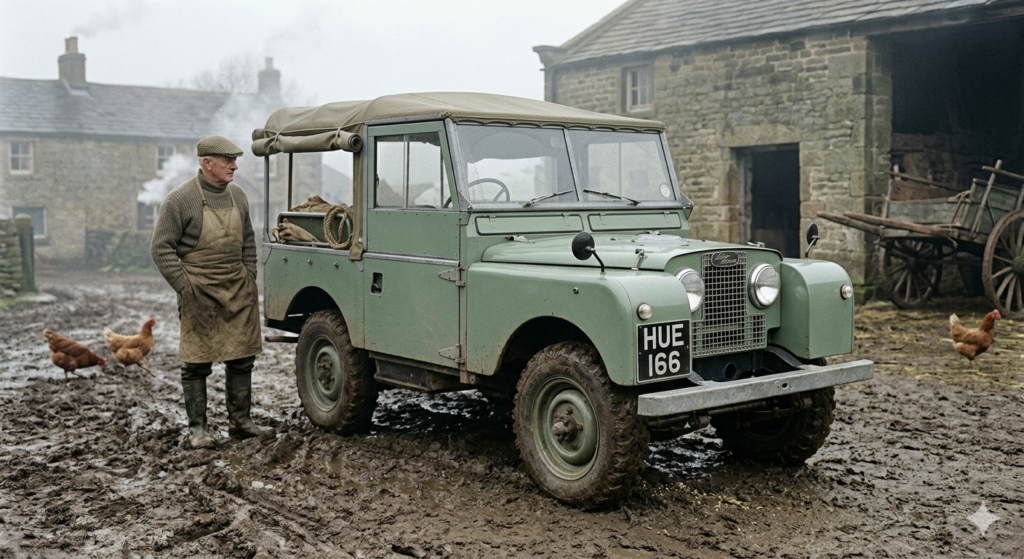
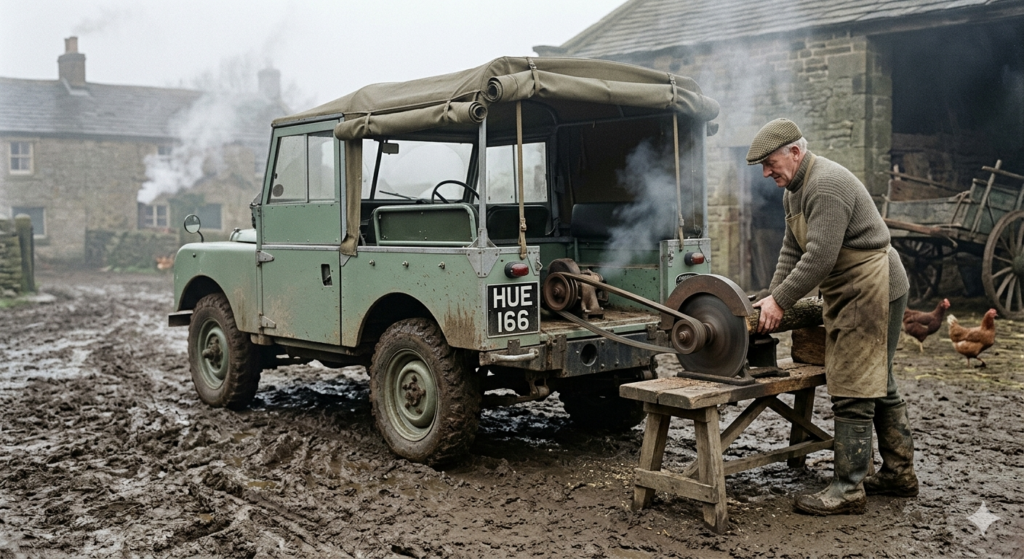
The Land Rover made its public debut at the Amsterdam Motor Show on 30th April 1948. Unlike the Citroën 2CV, which had been mocked by the press at the Paris Motor Show, the Land Rover’s reception was enthusiastic. Farmers, mining companies, and rural businesses recognized it instantly as exactly what they needed. Rover had hoped to sell around 5,000 in the first full year of production. They built and sold 8,000, and the orders kept coming.
By the end of 1948, the Series 1 was being purchased not just by farmers but also by military and police services and by organizations working in some of the most demanding environments on earth. It was exported to over 150 countries. By 1958, after just a decade of production, over 200,000 had been built. By 1968, total production across all Series models was approaching 600,000, of which more than 70% had been exported.
A vehicle conceived as a domestic stopgap had become one of Britain’s most successful exports. The Land Rover’s story, like the best in this series, is ultimately a simple one. A man needed a tool that didn’t exist. He built it from what was available, with no more complexity than the job required. The result outlasted almost everything else on the road.
