
The Electric Starter
Did Artificial Intelligence arrive overnight? Sometimes it surely feels so. We were so used to typing terms into a search box, and suddenly, one day in 2022, we started asking ChatGPT questions. Search terms changed to prompts. Prompt Engineering emerged (and soon died) as an entirely new job role. Adoption of AI, powered by LLMs, surged in almost every aspect of our lives, from businesses to students. Yes, it does feel like AI took over the world in a blink, especially in computer systems. But was it really that quick?
I have been pondering this question for some time as I started writing this new series of articles – AI on the Road. That led me to dig deeper into the origin of the term “Artificial Intelligence”.
The term “artificial intelligence” first appeared in a 1955 proposal by John McCarthy and colleagues for a summer workshop at Dartmouth. McCarthy later described the field as “the science and engineering of making intelligent machines.”
The foundation for tools or machines that could perform intelligently was laid decades before this definition was coined, by people who didn’t set out to build intelligent machines. Rather, they were trying to solve a specific, stubborn, and sometimes dangerous problem.
This series explores such problems in the automotive context and how the people working on them created machines that helped vehicles solve problems for humans. We start with a story that has nothing to do with computers, but a lot to do with a broken jaw.
To own and drive a car – a symbol of freedom – you also needed strength, timing, and a willingness to risk a shattered bone. As a result, car ownership wasn’t catching on.
The Crank
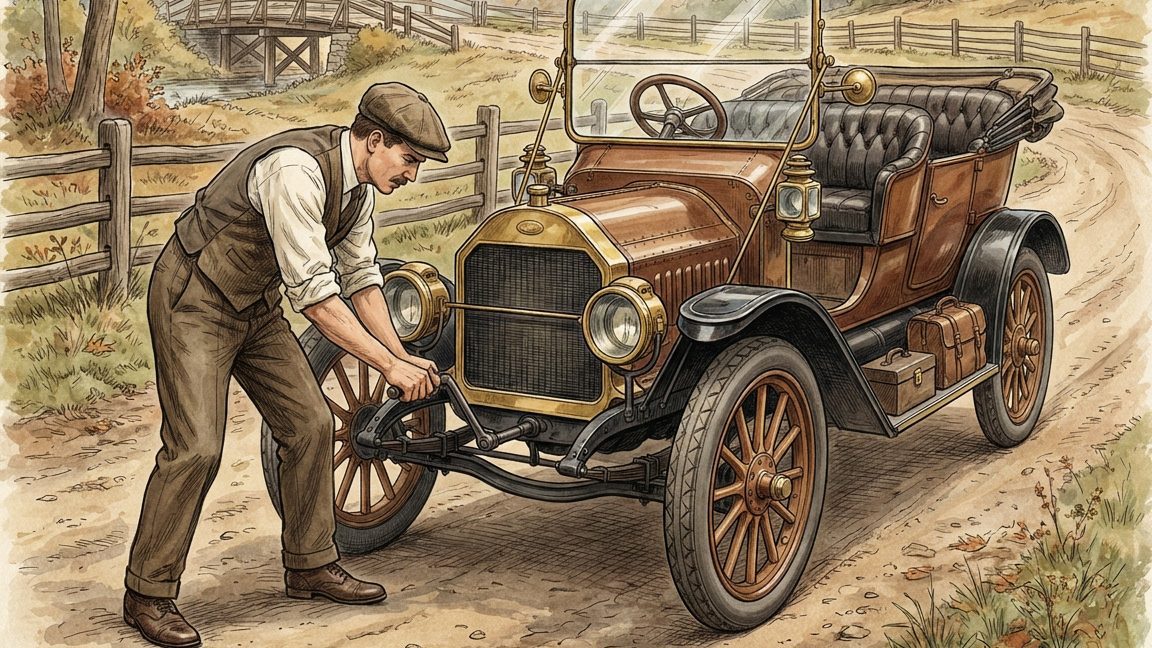
Early automobiles required a hand crank to start the engine. Over the years, drivers developed a method, though that didn’t reduce the inherent risks. Now imagine a cold morning in the early 1900s. Before you can get moving, the car required an elaborate wake-up ritual that needed to be followed exactly. Setting the spark lever and the throttle just so to retard the spark timing. Then you walk to the front of the car, bend over to grab the heavy metal hand crank lever, and turn it over – always pulling up, never pushing down – hoping the engine would catch it at the right time. If it didn’t, the engine would backfire, the crank would spin the wrong way, and snap violently against your hand.
This used to happen very regularly, often resulting in broken wrists, arms, and teeth. So much so that there was a name for it – the “Ford Fracture” or the “Chauffeur’s Fracture”. To own and drive a car – a symbol of freedom – you also needed strength, timing, and a willingness to risk a shattered bone. As a result, car ownership wasn’t catching on.
The Belle Isle Tragedy
This story is part history and part legend. Bryon Carter, owner of a car company, stopped on the Belle Isle Bridge in Detroit to help a motorist whose Cadillac had stalled. Bryon was a friend of Henry Leland, the head of Cadillac. He got out of his car and hand-cranked the engine, which fired back, hitting his face and breaking his jaw. Complications during the recovery led to pneumonia, causing his death. He was only 44 at that time.
The incident shook Leland. His friend was killed in the simple act of starting a car – a Cadillac. He decided that no one should have to take this risk in the future. To devise a solution, he turned to a young engineer from Dayton, Ohio, named Charles Kettering.
The Cash Registers Man
Kettering was the right person for the job. Before cars, he worked at the National Cash Register Company, where he developed a small motor to open the cash drawer, replacing the crank that the staff used to ring a sale. The successful invention taught him that a small motor could replace a human arm.
The idea of an electric starter wasn’t new. Inventors had tried it since the late 1890s. The problem was one of constraint. To turn over a cold engine, a motor needed to deliver a large amount of power, and a motor that could do so was too big and heavy for a car.
Kettering realized a starter motor only needs to work in short, intense bursts, meaning it could be built much smaller without overheating. He designed a compact, dual-purpose unit that acted as a starter motor to turn the engine over, then switched to a generator to recharge the battery once running.
Adoption
Cadillac adopted Kettring’s self-starter in 1912. Drivers pressed a pedal or a button to start the engine, and that was it. Other makers soon followed the lead. By the late 1910s, the crank had begun to disappear.
Removing the crank didn’t just make cars safer; it also opened the consumer market (especially for women drivers, who previously favored early electric vehicles because gas cars required immense upper-body strength to start) and effectively killed the first wave of electric cars for a century.
Why does this story belong here?
You might ask what a starter motor has to do with AI. If you look closely at what happened – for the first time, a car did something on its own that a human had always done. It was not thinking, but it was a first step: a task moved from the driver to the machine, and the driver stopped needing to know how it worked.
Everything that followed repeats that pattern. The automatic transmission took over the gearshift. Cruise control, which you can read about in our Turning Points series, was the first step towards driving automation. Anti-lock brakes took over the pumping of the pedal. Each one began as a need, was shaped by a constraint, and shifted a little more judgment from our hands to the car. Today’s driver assistance systems are the newest chapter in a book that started with a crank.
There is more to say about Kettering, who went on to invent much else, including refrigerants and the automotive paint finishes that carried his name through General Motors. But for now, we will leave it here.