Image: AI Generated. The Vespa and Ape in their contemporary surroundings.
In a recent article in the necessity series, I wrote about how Kei Cars played an important role in Japan’s post-Second World War reconstruction. Japan needed a simple, cheap, and reliable means of transporting goods and people due to the severe resource and financial constraints. Kei cars were the innovation that made it possible.
In Europe, Italy was in a similar situation. As an Axis power, it had suffered significant damage during the war. Though the extent of the damage wasn’t as devastating as that of Germany or Japan, a large part of the country’s infrastructure, like rail yards, ports, and factories, was destroyed. So, like Japan, the end of the war was followed by an immediate need to rebuild the country.
Interestingly, in Italy, a multitude of coincidences (or necessities) came together to produce not one but two iconic vehicles that fulfilled their purpose so well that they gained worldwide affection for their simplicity, affordability, and reliability. These vehicles were the Vespa Scooter and its sibling, the Ape three-wheeled goods carrier.
Think about it; the Vespa was born because Piaggio had to stop manufacturing airplanes.
First, Piaggio, the renowned aircraft manufacturer, well known for making bombers, fighter planes, and powerful engines during and before the war, was banned from building military aircraft as a part of the post-war prohibitions on Italy. It had a large roster of engineers, designers, and workers who needed work. It needed a pivot, and fast.
Second, People needed a means of transportation that was cheap to buy and economical to run. In a war-ravaged country, very few could afford cars.
And finally, the rebuilding effort required moving goods. Small business owners, such as bakers, farmers, and building contractors, who needed to transport their goods, didn’t have the money to invest in a four-wheeled vehicle, let alone buy fuel for it. There was another challenge: commerce in Italy was conducted in medieval town centers, with narrow, winding streets that even the smallest pre-war trucks found difficult to navigate.
This triple necessity of industrial survival, personal mobility, and goods transportation led Piaggio to launch the Vespa in 1946, followed by the Ape in 1948. Enrico Piaggio, from the founding family, tasked aeronautical engineer Corradino D’Ascanio with designing a new mobility solution. Thankfully for the world, D’Ascanio hated motorcycles. He used his background in aircraft design to create the Vespa.
Think about it; the Vespa was born because Piaggio had to stop manufacturing airplanes.
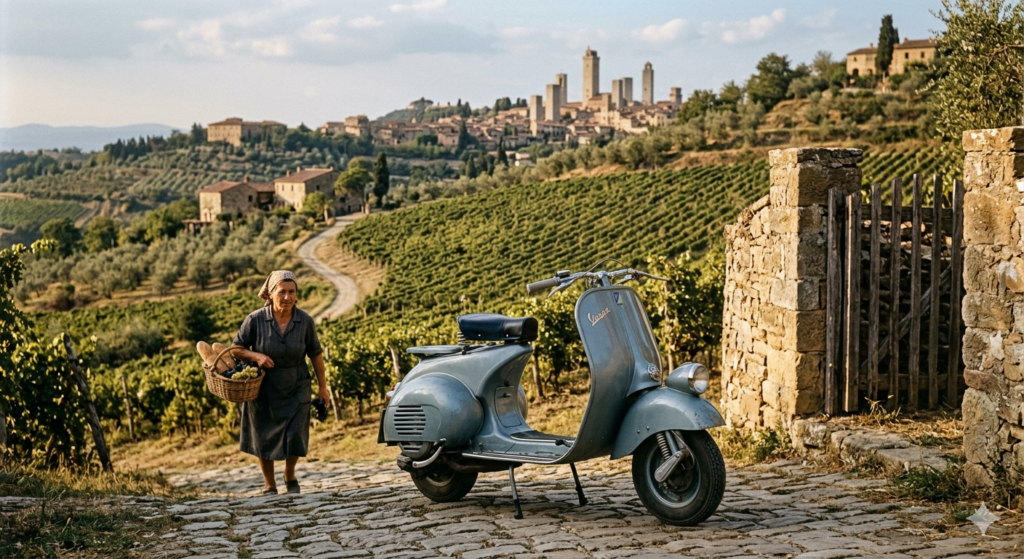
Image: AI Generated. A Vespa in a beautiful Italian village
D’Ascanio leveraged his aeronautical experience to bring several features from the aircraft to the humble Vespa. The major ones are the monocoque (unibody) design, aircraft-derived handlebar gear shifter, and landing-gear-based front suspension, which allowed quick wheel changes. The result was a comfortable, easy-to-ride vehicle.
Vespa means a Wasp, happily buzzing around town, perhaps sounding like one. Ape, meaning “Bee,” reflects its hardworking nature.
In a market used to motorcycles, this odd-looking two-wheeler with small wheels looked “unmanly” and didn’t find immediate favor. Apart from its looks and shape, folks couldn’t imagine it safely navigating the bombed-out roads. However, after a very slow start, sales eventually increased, making it one of the most successful vehicles ever. The Vespa is such an important vehicle in automotive history that it deserves its own story, and we will do that soon. For now, we will recognize its role in providing an economical means of transportation globally and move on with this article.
By 1948, Vespa had begun to see some success. Piaggio now shifted its focus to solving the challenge of moving goods and supplies across Italian villages and towns, which were still reeling from the effects of the war. As we wrote earlier in the article, the Italian market and roads were not conducive to even small trucks. Once again, Corradino D’Ascanio was entrusted with finding a solution
Given the financial constraints, it wasn’t possible to invest in full-scale R&D to develop a new solution. D’Ascanio had to work with what he had, and he did. The Vespa became the “donor” vehicle. D’Ascanio mated the front end of the Vespa to a simple two-wheeled rear axle with a flatbed, and the Ape (Ah-peh) was born. The naming of the vehicles was ingenious, too.
Vespa means a Wasp, happily buzzing around town, perhaps sounding like one. Ape, meaning “Bee,” reflects its hardworking nature.
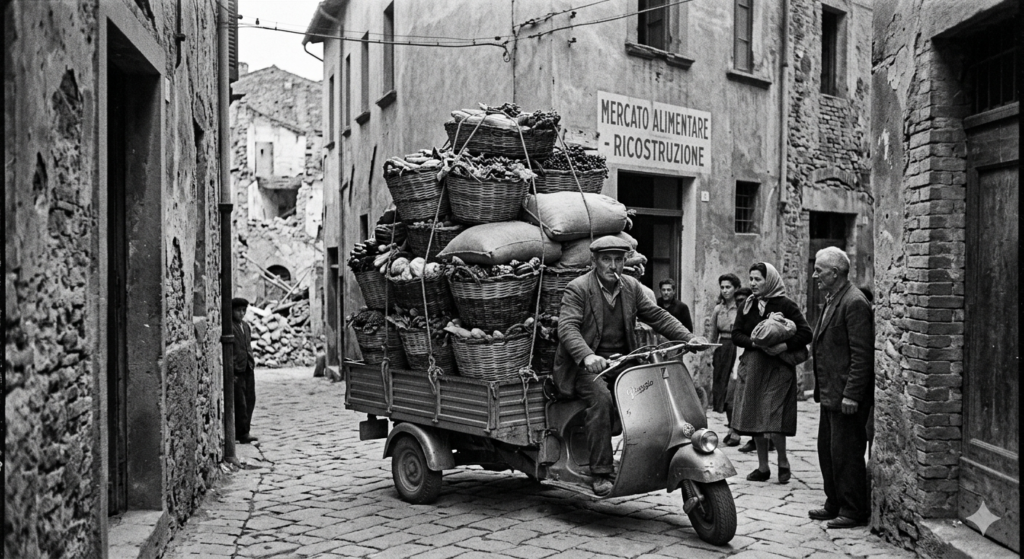
Image: AI Generated. Ape, the workhorse
Motorcycles with sidecars were popular before and during the war. But rather than follow the same concept, D’Ascanio fitted a real differential at the rear with a chain drive, thus enabling it to navigate the twisty hills of the Italian towns and villages with ease. The engine and transmission were toned down to focus on torque over speed, so the Ape could carry a load of goods up the winding roads without breaking a sweat.
Similar to the Vespa, the original Ape had an “open-air” seat for the driver. As Ape gained significant adoption, a cabin was added for the driver, making it an all-weather vehicle.
Both the Ape and Vespa played vital roles in economic recovery, serving customers worldwide. In India and Southeast Asia, they became essential workhorses, lifting millions out of poverty.
The story once again exemplifies how a necessity (three, in this case) led to innovations that have continued to improve people’s lives for decades.
