India achieved independence from the British in 1947, two years after the Second World War ended. Unlike Japan and Italy, India wasn’t destroyed by the war. However, its challenges were similar. While the industrial and transportation infrastructure in Japan and Italy was wiped out during the war, India had little infrastructure in place when it gained independence. Generating employment for the country’s population was one of the top challenges the new leadership faced.
India’s economy during this time was ideologically aligned with socialism. Developing an indigenous manufacturing industry was vital, and this required the imposition of protectionist policies. The country was extremely poor due to centuries of foreign rule. Wasting valuable foreign exchange on a “luxury” like a passenger car was unfathomable, but vehicles were still needed for personal, commercial, and government use.
The adoption of the Industrial Policy Resolution in 1956 made a conscious decision to build vehicles domestically with at least 90% local content. This drove out manufacturers such as Ford and GM, which were assembling vehicles with foreign-made components. The government regulation (or overreach) went further. They didn’t just mandate local manufacturing; they even set a quota for how many could be built. As expected, the production capacity limit had unintended (and poor) consequences, but that is beyond the scope of this article.
India’s two major car manufacturers were located at opposite ends of the country. This factor played a significant role in their adoption.
With foreign manufacturers out of the picture, it was left to Indian industrialists to address the mobility challenges while remaining compliant with regulations. Hindustan Motors, owned by an Indian business family, the Birla group, was already assembling the Hindustan Landmaster based on the Morris Oxford Series II. In 1957-58, they bought the entire tooling for the newer Oxford Series III, brought it to India, and established a new factory in West Bengal. Bringing over the entire factory met the government’s 100% indigenous manufacturing requirement.
In 1964, Premier Automobiles Limited (PAL), which previously assembled Chrysler products, started a collaboration with Fiat to launch the Fiat 1100D. We have already written about Fiat’s influence on the Automotive industry of the Eastern Bloc countries. India also benefited greatly from Fiat’s knowledge sharing over several decades. PAL started manufacturing the 1100D at its Mumbai plant. The 1100D was renamed the Premier Padmini in 1974, but throughout its almost 4-decade life, no one called it that. It was and remains a Fiat.
India’s two major car manufacturers were located at opposite ends of the country. This factor played a significant role in their adoption.
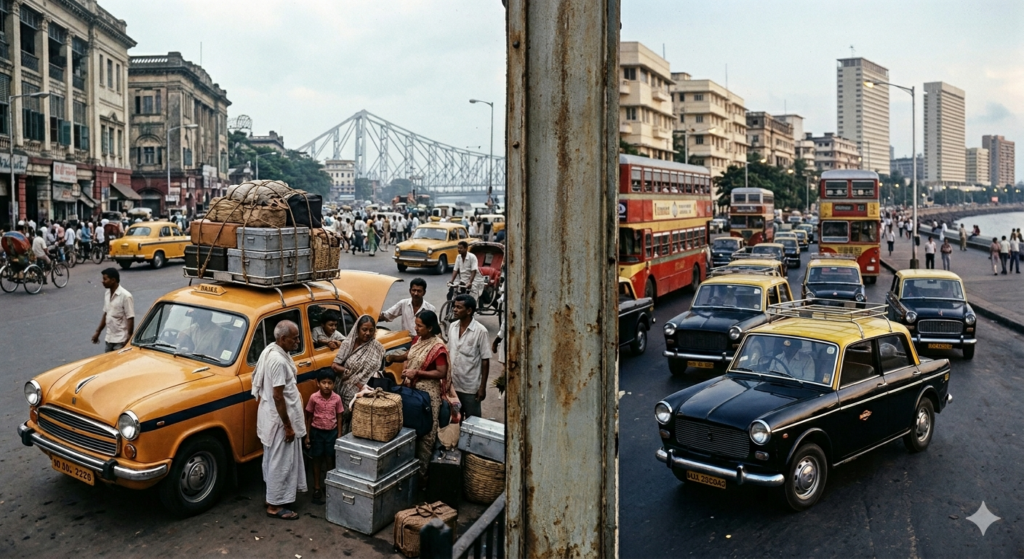
The Ambassador and the Padmini playing their role as taxis in Kolkata and Mumbai, respectively
Most people growing up in India in the 60s to 80s took their first car ride in an Ambassador. Unless they grew up around Bombay (Mumbai) or the western part of the country, then it was the Fiat.
And for a vast majority of weddings during the same period, the designated wedding car was an Ambassador. Unless the wedding was in or around Bombay (Mumbai), it was the Fiat.
A taxi in Calcutta (Kolkata) would be an Ambassador. In Bombay (Mumbai), it would be a Fiat.
For those who could afford cars, if they had a larger or a joint family, they owned an Ambassador. If they were from a nuclear family, it would have been a Fiat.
Company cars for official work would be Ambassadors. The private cars of the senior employees of these companies would be Fiats. And government cars were always Ambassadors.
While these are great for narration, they cannot hide the sad truth that government regulations led to a duopoly among these manufacturers.
From the comparisons above, you can see that the Ambassador and the Premier Padmini met India’s unique set of requirements (or necessities) in their own way.
Both these cars were fairly simple in design and construction, but also rugged, ensuring they could survive the country’s universally poor roads and be repaired cheaply anywhere. I remember a personal story of the Ambassador from January 1988. There were 8 of us taking a cross-country trip for a family wedding. The car was loaded with stuff for the wedding – not just in the trunk but even on the overhead carrier. We were driving through an area that was under the planned submergence zone of a dam, which meant there was no road – just rocks and gravel for miles. Soon, a rock punctured the car’s oil pan. The driver was unnerved. He inspected the damage, took out his bar of washing soap and his handkerchief, beat them together into a ball with a spanner, and plugged the hole. This arrangement worked for over a month and hundreds of miles until the car returned to its original location.
There are unlimited stories of these cars’ ruggedness. While these are great for narration, they cannot hide the sad truth that government regulations led to a duopoly among these manufacturers. The Indian people suffered with poor quality vehicles and no recourse for any customer service. It wasn’t until 1983, when the Suzuki Alto was launched as the Maruti 800, that Indians could access a better, more modern vehicle.
Today, the Indian automotive industry is one of the most competitive in the world, with almost all leading global brands present. The new generation of Indians would never see an Ambassador or a Padmini, but their role in putting the country on wheels is undeniable.
